A Black Line or a Purple Nail: How to Tell a Bruise From Something a Doctor Should See
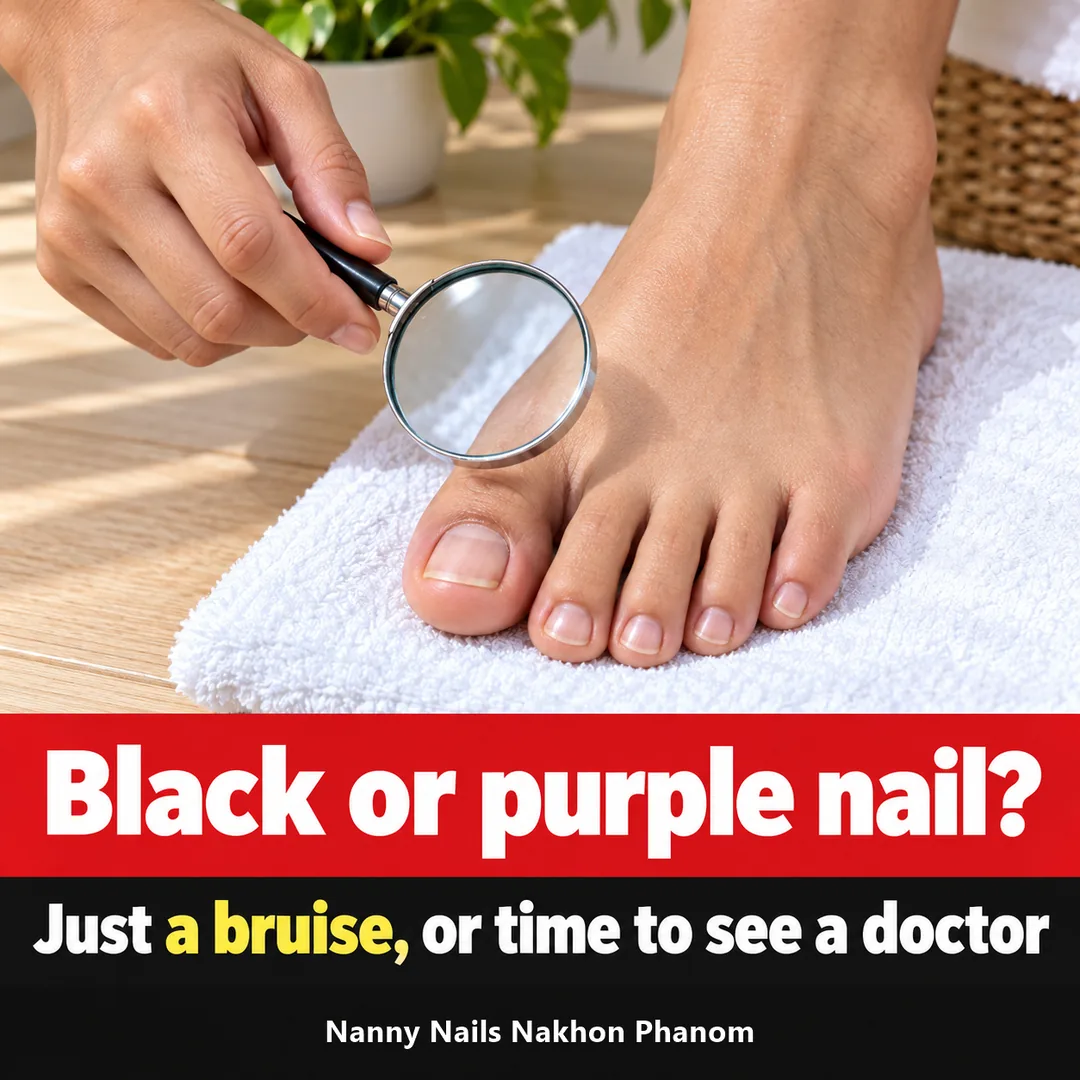
You take your shoes off after a long day on your feet and find your big toenail has turned a deep purple. Or one day, waiting for a bus, you notice a dark brown line running from the base to the tip of your thumbnail. You search on your phone, the word cancer shows up in the results, and your stomach drops. This article helps you tell apart the dark and purple nails that are just a bruise you can let grow out, and the ones you should not wait on, the ones a doctor should see.
The good news first. The purple or black nail people see most often is blood trapped under the nail after a knock, which doctors treat as a minor injury. It hurts for a few days, then the colour slowly grows out with the nail. Dark lines on nails also have plenty of causes that are not cancer. But some lines have features doctors want to see early, and this article points them out one by one.
Black nails and purple nails come in several kinds
When people say a nail has gone black, they can mean quite different things. Before you worry, see which of these your nail looks most like.
- A red, purple or black patch after a knock This is blood under the nail, called a subungual hematoma. It is the most common kind, especially on toenails.
- A brown or black line running from the base to the tip Doctors call this longitudinal melanonychia, a dark band along the length of the nail. It has many possible causes.
- A dark line with unusual features such as a wide band, uneven colour, or colour spreading onto the skin around the nail. This is the group a doctor needs to check to rule out melanoma, a type of skin cancer, in the nail.
- Several nails turning dusky purple at once with no knock at all. This usually has to do with cold or with blood not carrying enough oxygen. It is a different story, covered near the end.
Nail fungus can also turn a nail brown or black, but it usually comes with a thick, brittle nail and colour that starts at the tip. That topic has its own article: nail fungus or just yellow: 5 things to check before your nail appointment.
What is blood under the nail?
A subungual hematoma is a bruised nail. The nail is crushed, slammed or struck, small blood vessels under the nail plate break, and blood collects under the nail. That causes swelling, pain and a change of colour. At first it looks red or purple, then it gradually darkens to deep brown or black.
It can throb for a while, but the pain usually eases on its own within a few days. The colour does not fade where it is. It moves out with the growing nail. It can take six to nine months for the nail to grow out completely and return to its normal colour, and toenails take longer than fingernails.
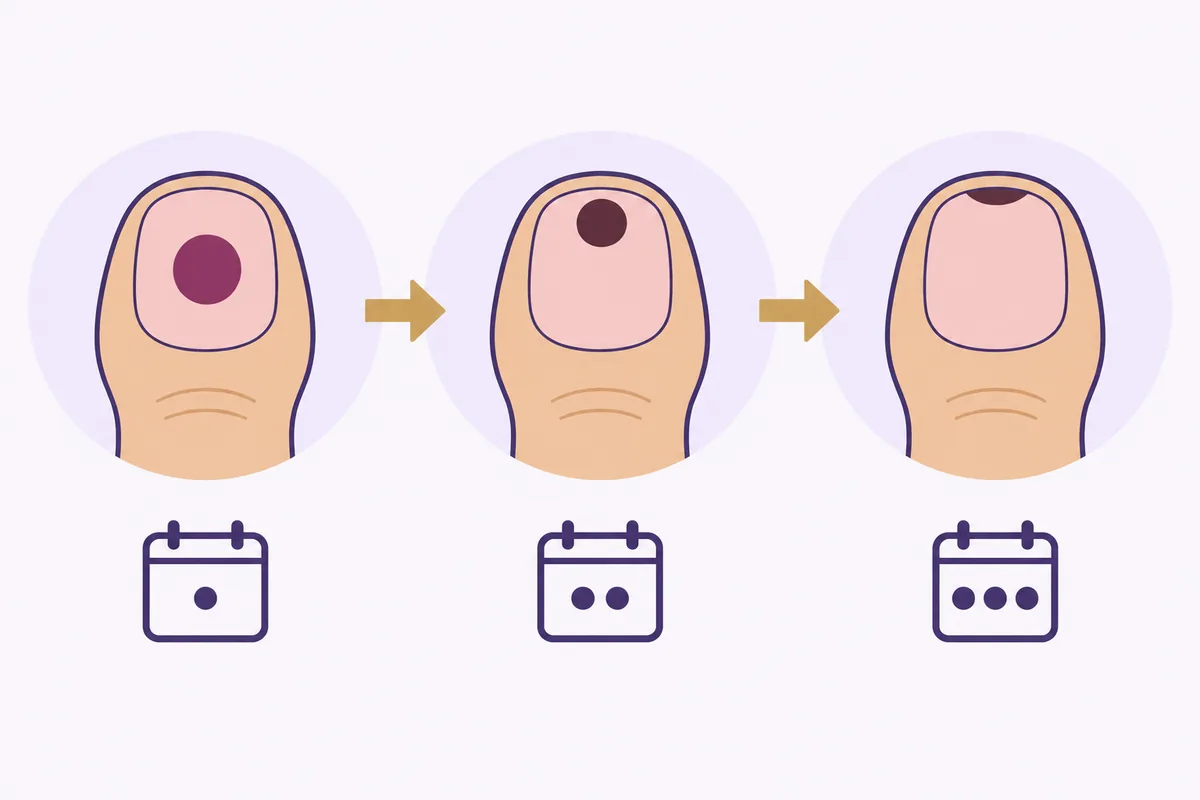
The diagram shows what happens to a bruise under the nail over time. The key sign is this: within a few weeks of the injury, new nail of normal colour appears at the base, with a clear edge between it and the dark patch. The patch then keeps moving towards the tip until it is trimmed away. That is the best evidence that it is a bruise.
What causes a black toenail?
Black or purple toenails are more common than fingernails, because feet carry your weight and spend all day in shoes. These are the causes we hear about most.
- Dropping something on your foot, or stubbing a toe on a table leg, a door frame or a flower pot. You will remember exactly when this happened.
- Tight shoes pressing on a nail again and again An example is running in shoes so tight they press on one toenail. A small push with every step adds up to a bruise.
- Small knocks you do not remember Many toenail bruises come from repeated minor trauma from tight or badly fitting shoes, so people cannot recall hurting the toe. Think of a whole day at an event in pointed shoes, a long walk downhill, or a sport with sudden stops.
- Fungus or bacteria Nail fungus can turn a nail brown, black or greenish black, and a greenish black nail can also be a bacterial infection that needs treatment. These usually do not look like the round patch of a bruise.
Not remembering a knock does not mean something is wrong. It is just a reason to watch a little more closely, using the checklist below.
Checklist: this is probably just a bruise
If your nail matches almost every point, it is most likely a bruise you can let grow out.
- You know the cause a knock, something heavy, or tight shoes shortly before.
- It appeared quickly A bruise under the nail shows up within hours of the injury, unlike melanoma, which develops over months.
- It is a patch, not a straight line round or shapeless, not a band running from base to tip.
- The colour changes over time from red or purple to dark brown or black.
- New nail at the base looks normal, and the patch moves up Take a photo now and another in 3 to 4 weeks. You should see the patch moving away from the base.
- The skin around the nail is its normal colour with no dark colour spreading onto the cuticle or the side folds.
When a bruise needs a doctor straight away
Even a real bruise sometimes needs a doctor now.
- Severe pain, or pain that keeps getting worse A doctor can drain the blood by making a small hole in the nail plate, a procedure done by a doctor. Severe pain in the first 48 hours is a reason to have a doctor consider it.
- You think a bone may be broken for example after something heavy fell on the toe, or the toe is swollen and out of shape.
- Signs of infection red, swollen skin around the nail, or pain that comes back.
- You are not sure it is a bruise for example you cannot remember any knock, and weeks later the colour has not moved at all.
What causes a black line on a nail?
Now for dark lines. This is called melanonychia: brown or black colour in a nail, either across the whole nail or as a band along its length. The colour comes from melanin, the same pigment that gives skin its colour, not from blood.
It sounds alarming, but these lines are very common in people with darker skin. They are found in up to about 20% of Japanese people, and nearly all Afro-Caribbean people develop brown-black nail pigment by age 50. Causes that are not cancer include:
- Skin colour and ancestry People with darker skin see it more, often on several nails.
- Pregnancy
- Repeated trauma to the nail such as biting, chewing, picking or breaking nails often.
- Some medicines particularly some chemotherapy drugs.
- Some skin conditions such as psoriasis and lichen planus.
- A mole in the nail matrix (the matrix is the nail factory hidden under the skin at the base of the nail), more common in children.
The key difference from a bruise is that a pigment line is made by the nail factory itself. So it runs continuously from base to tip and does not grow out and disappear the way a bruise does. Our plain advice: the line is often mistaken for a bruise, but unlike a bruise, skin cancer does not grow out with the nail.
Warning signs to get checked early
Melanoma of the nail is rare. It accounts for about 0.7% to 3.5% of all melanomas worldwide, and is more common in people of Asian, African-American and Hispanic descent, between the ages of 50 and 70. Rare as it is, make an appointment with a doctor as soon as you see a warning sign, so it is worth knowing what they are.
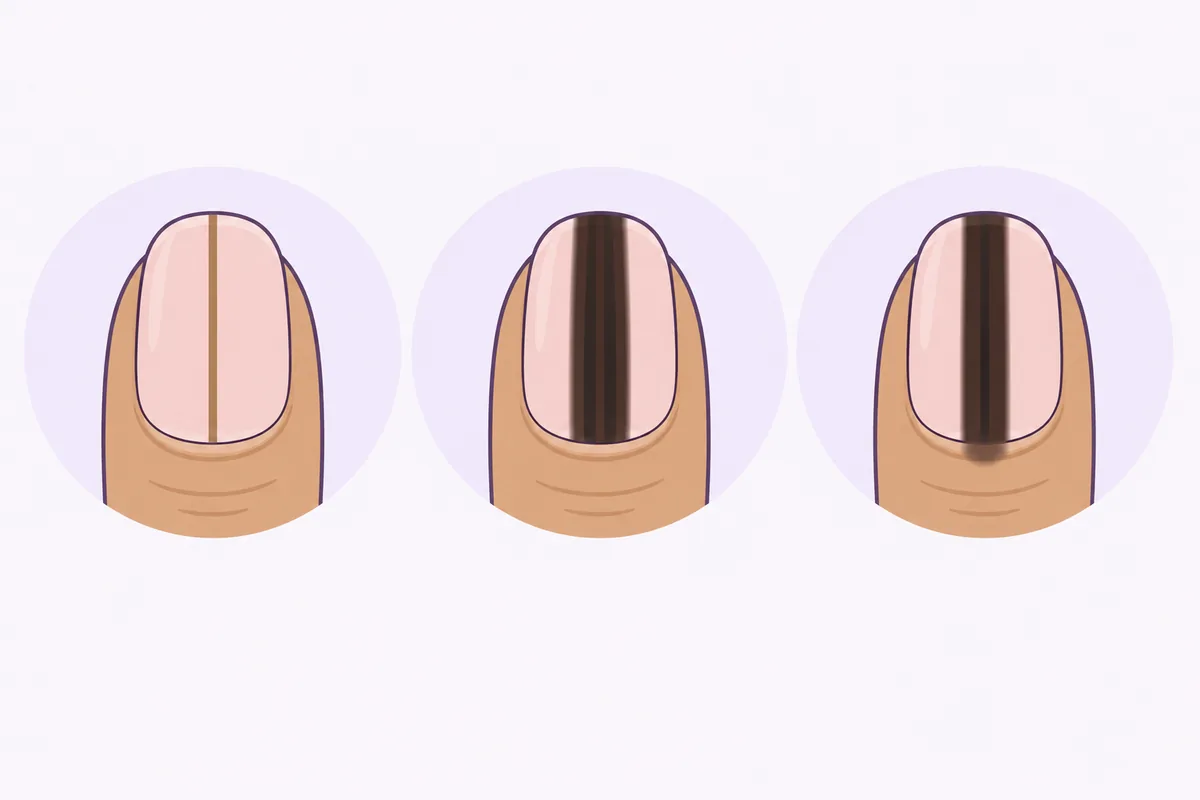
The diagram compares three kinds of line. Left: a narrow line of even colour. Middle: a wide band with uneven colour. Right: a band whose colour spreads onto the skin at the base of the nail. The last two match the warning signs that need a doctor. The one on the left still deserves a doctor's look if it is new.
See a doctor if you notice:
- A new dark line, or one that is changing It often looks like a brown or black band, frequently on the thumb or big toe of your dominant side.
- Darker skin next to the nail Doctors call this Hutchinson's sign: colour spreading from the nail onto the cuticle or side folds. It can be a sign of advanced melanoma.
- The nail lifting away from the nail bed with no other explanation.
- The nail splitting down the middle.
- A bump or lump under the nail or bleeding from the nail without an injury.
Nail melanoma usually starts as a narrow band on a single nail, and over time the colour inside it can become uneven, the edges blurred, and the colour can spread onto the surrounding skin. Doctors use the ABCDEF rule to help assess it. In plain words:
| Letter | What the doctor looks at |
|---|---|
| A Age and ancestry | Age 50 to 70, and some ancestries, such as African, Japanese and Chinese |
| B Band | A brown-black band 3 mm wide or more, with blurred edges |
| C Change | The band changes over time |
| D Digit | Big toe, thumb and index finger are most often affected. The big toe and thumb together account for 75% to 90% of cases |
| E Extension | Colour spreading beyond the nail, Hutchinson's sign |
| F Family history | You or a family member have had melanoma |
This table is not for scoring yourself at home. Someone who ticks several boxes may have nothing wrong, and someone who ticks one should still get checked. It is here so you understand why a doctor asks about your age and family and wants to see every nail.
Side by side: bruise, or something a doctor should see
| What to look at | Usually a bruise | Have a doctor check |
|---|---|---|
| Cause | You remember a knock or tight shoes | No injury, it appeared on its own |
| How fast | Within hours | Becomes clearer over months |
| Shape | Round or shapeless patch | A line or band from base to tip |
| As the nail grows | Patch moves up, new nail at the base is normal | The line still starts at the base |
| Skin around the nail | Normal colour | Dark colour spreading onto it |
| Width and colour | Purple turning black, then shrinking | Wider, darker, or uneven colour |
If you have read this far and still cannot say which column your nail belongs in, that is your answer: go and have a doctor look. Being told it is nothing is not wasted time. It is a good night's sleep.
What causes a purple nail if you did not knock it?
Some people see several nails turn purple or bluish at the same time without any injury. Bluish skin, lips or nails is called cyanosis. It happens when the blood is not delivering enough oxygen to that area.
- Only fingers and toes Common causes are cold, like sitting in a very cold air-conditioned room, and Raynaud's phenomenon, where the small blood vessels in the fingers tighten in the cold or under stress. Fingers go pale and may then turn purple. Warm and gently massage them, and it is worth seeing a doctor if it happens often.
- Go to hospital straight away if purple or bluish nails or lips come with difficulty breathing, chest pain, confusion, unusual exhaustion, or coughing up blood.
In short: one purple nail after a knock is usually a bruise. Several purple nails at once without a knock is a different matter, about your body as a whole.
Getting ready to see a doctor
You do not need to be sure before you go. But having this ready makes the appointment easier.
- Photos of the nail in daylight close up, straight on, from the same angle each time. A ruler beside the nail helps show whether a line is getting wider.
- When you first noticed it and whether you remember a knock or new shoes around then.
- Medicines you take regularly and any health conditions.
- Family history whether anyone in the family has had skin cancer.
- Remove nail polish before you go The doctor needs to see the real nail and the skin around it.
A doctor may look at the nail with a magnifying tool called a dermatoscope and, if still unsure, take a small tissue sample (a biopsy), which is the only way to confirm. Nobody can tell from a photo alone, this article included.
Can I cover a black nail with gel polish?
We understand the question. A toenail can stay dark for months, and open shoes feel awkward. But if it is a line or patch you cannot yet explain, do not hide it under solid colour. Polish covers exactly what you need to watch: whether the patch moves, how wide the line is, and the colour of the skin around the nail. Having a doctor look first is the safest route.
If the black or green colour comes with a thick, crumbly nail and looks like fungus, we will not paint over it, because the nail process adds moisture, from nail polish remover and from keeping the nail sealed under colour, and a fungus could spread. See a doctor first. The first checks are in nail fungus or just yellow.
Once a doctor says the nail is fine, or a bruise no longer hurts, the nail is not lifting and the patch has almost grown out, you can have your nails done as normal. A greige nude like this one goes with every day and every pair of shoes.

Or, after months of keeping your feet in closed shoes, a plain red is the classic that never misses.

| Service | Price |
|---|---|
| Gel colour, toenails, 1 colour | 250 baht |
| Gel colour, toenails, 2 to 3 colours | 300 baht |
| Gel removal only, nail rest (includes shaping) | 100 baht |
Gel colour prices include shaping, base coat and top coat. See the full menu on the services and prices page. Every job comes with our 7-day care period.
What customers say about us
(So beautiful. Good, detailed work, a plain colour that came out gorgeous. Exactly what I wanted. She is kind and shapes your nails with so much care. Highly recommend.)Google review by ภาณุพงศ์ ธรรมเสนีย์
(This place does beautiful nails. The owner is lovely and gives good advice.)Facebook review by Sujitra Hongsomdee
Read all reviews on the reviews page.
The short version
A purple or black patch after a knock or tight shoes is usually a bruise. It hurts for a few days, then moves up with the nail until it is trimmed off in six to nine months, longer on toenails. Severe pain, a possible broken bone or signs of infection mean a trip to the doctor.
A black line running from base to tip has many harmless causes. But a line that is new or changing, wide, uneven in colour, on a single nail, or spreading onto the skin around the nail should be seen by a doctor without waiting. For yellow or thick nails that might be fungus, read nail fungus or just yellow, and for toenail colours to enjoy once your nails are ready, browse the gallery.
FAQ
What causes a black toenail?
Most often blood under the nail after a knock, something heavy falling on it, or tight shoes pressing on it again and again, sometimes without you remembering. Fungus and bacterial infection can also turn a nail brown, black or greenish black. A dark line running from base to tip is a separate matter that a doctor should see.
Is a black line on a nail dangerous?
Many causes are harmless, such as skin colour, pregnancy, biting or picking nails, and some medicines. But see a doctor for a line that is new or changing, wide, uneven in colour, or spreading onto the skin around the nail, to rule out melanoma, which is rare but not something to wait on.
What causes a purple nail?
One purple nail after a knock is usually a bruise under the nail. Several dusky purple nails at once without a knock can come from cold or from blood not carrying enough oxygen. If it comes with difficulty breathing, chest pain or confusion, go to hospital straight away.
How long does a bruised, black nail take to go away?
The pain usually eases within a few days, but the colour only goes once that part of the nail grows out and is trimmed off. This can take six to nine months, and toenails take longer than fingernails.
Can I cover a black nail with gel polish?
If you do not yet know what the dark colour is, do not cover it with solid polish, because you will not be able to see the changes you need to watch. Have a doctor look first. If it looks like fungus, we will not paint over it, because the nail process adds moisture that could help a fungus spread.
What is the salon’s 7-day care period?
If work done at the salon lifts or peels within 7 days, bring it back and we will fix it for free.
Where is the salon and how do I book?
We are in Ban Noi Tai, Soi 7/1, Mueang Nakhon Phanom. Open every day, nail appointments 09:00 to 18:00, 3 bookings a day. Book on LINE @nannynails or call +66 99 002 8935.
Nails ready? Send us a photo and pick a colour
Once a doctor says your nail is fine, send a photo of your feet or hands as they are now, or a design you like, on LINE. We will help you choose between an everyday nude, a classic red, or a small design on the big toe. We look after colour and shape; your doctor decides about nail health. We take 3 bookings a day, between 09:00 and 18:00.
Read more