Nails Peeling in Layers After Gel Removal: Where Did It Go Wrong?
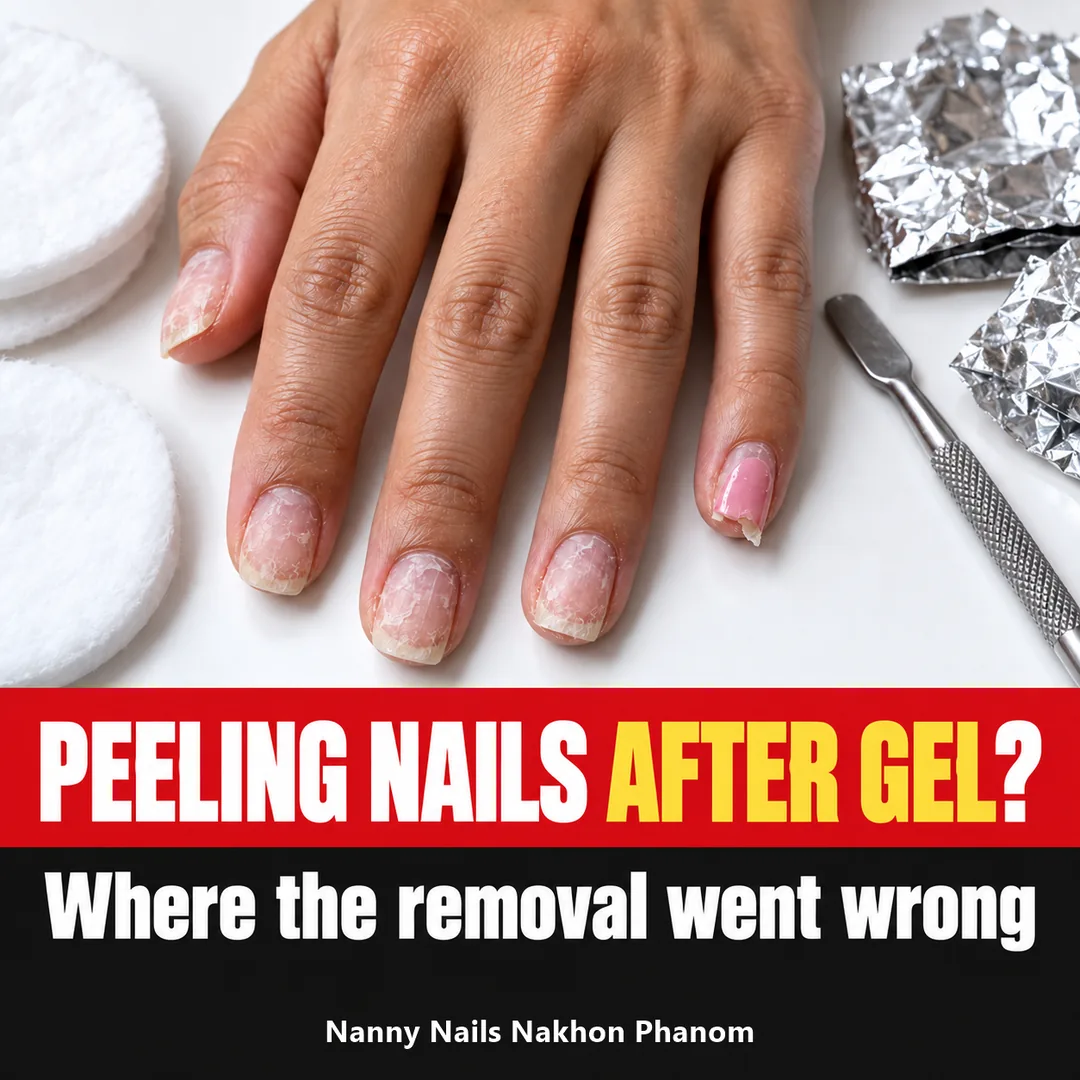
The day the gel came off, your nails looked fine, just a little pale. A week later the tips have started to split into thin sheets, the surface has cloudy white patches as if it has been scraped, and some nails are soft enough to bend when you press them. Many people conclude straight away that gel ruins nails. But look closer and most of the damage did not happen while the gel was on. It happened in the few minutes it took to come off. This article walks through where things go wrong when nails peel in layers after gel removal, how to read the clues on your own nails, and how to look after them before the next set.
If you are reading this with peeling nails right now, do not panic. The layers that are peeling belong to the old tip of the nail. The nail growing out from the base is new and never went through that removal at all. Once you know what went wrong, you do not have to go through this again next time.
Why do nails only start peeling after the gel comes off?
While gel is on, it works like armour over the whole nail. Water cannot reach the surface, soap cannot reach it, and the gel holds the layers at the tip together so they cannot split. That is why nails look strong for the two or three weeks you wear it. Once the armour comes off, whatever is underneath is on show.
Gel manicures can cause nail brittleness, peeling and cracking, and we see again and again that it is the removal process that damages the nail. In plain terms, the gel does not eat into your nail. Taking it off the wrong way, by pulling, scraping, filing or soaking in remover for a long time, thins and dries out the top layers.
A nail plate is keratin stacked in many layers, like paper. When part of the top layer has been pulled or scraped away and the nail is still dry from remover, going back to washing up and hand washing as usual is enough for the loosened layers to start separating at the tip, one at a time. That is why peeling tends to show up several days after removal, not straight away. If your nails peel from everyday habits with no gel involved, that has its own article: why do nails peel in layers: 6 everyday causes.
Read your nails to see which step went wrong
Each kind of damage leaves a different trace. Compare your nails with this table to get a rough idea of what went wrong last time. It is a guide, not a diagnosis, and many people have more than one at once.
| What you see | Usually comes from |
|---|---|
| Patchy white, rough areas on the surface, some smooth and some dull | Picking or pulling the gel off, taking sheets of the top nail layer with it |
| The whole nail is thin, bends when pressed, stings with hot water | Filing or grinding too deep, into the real nail |
| The tip splits into layers, looks chalky and very dry | Long soaks in remover, no moisturising afterwards, sawing the tip with a file |
| Scratches along the nail, or white spots appearing later | Scraping or prising hard with something rigid before the gel had softened |
| Dry, peeling, red or stinging skin around the nail | Dipping whole fingers into a bowl of remover |
5 removal mistakes people make without noticing
Everything below is something people do to get it over with faster, or because they think it does no harm. The correct step-by-step method is already written up in can you remove gel nails at home. Here we look at what each mistake does to the layers of the nail.
1. Pulling lifted gel off in one piece
This is the number one cause of peeling after gel. After two or three weeks, gel often lifts at the edge, and once there is a corner to grab, fingers start picking at it in front of the TV. When the gel pops off in one sheet it feels easy and clean. But gel bonds tightly to the nail surface, and every piece you pull off takes some of the top nail layer with it.
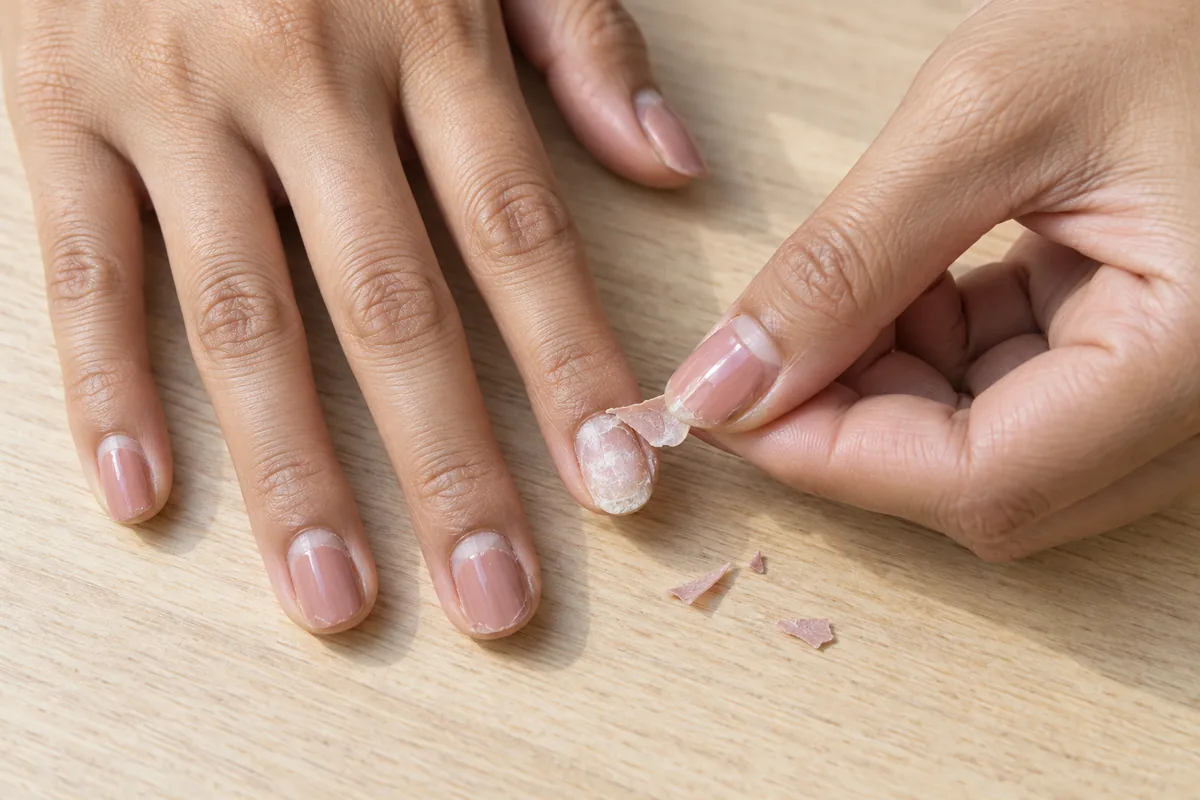
Look at the underside of a piece of gel you have pulled off. If you see a thin white film stuck to it, that is your own nail. Picking or filing off gel yourself can significantly damage nails, so book a proper removal instead of picking. A nail that has had patches of its top layer torn away is thinner in those spots than around them, and that is exactly where peeling starts. If your gel has just lifted and you are not ready to take it off, read gel nails lifting: leave them or go to the salon.
2. Filing through the gel and into the nail
Before soaking, the shiny top coat has to be filed until it is matte so the remover can get in and dissolve the gel. The problem is that many people keep going, wanting the gel as thin as possible, until the file reaches the real nail without them realising. Gel colour and nail sit right against each other, so the dividing line is hard to see.
One round of filing too deep thins the whole nail immediately. The result is a nail that bends, stings easily, and has a tip too thin to hold its layers together. Filing off gel yourself can seriously damage nails. File just enough to take the shine off, and let the remover do the rest.
3. Soaking whole fingers in a bowl of remover for too long
Many people pour remover into a bowl and dip their whole fingers in while watching a series, assuming the longer they soak, the easier the gel will come off. But acetone draws water and oils out of the nail and skin every minute it is in contact. The skin around the nails turns white, dry and tight, and the nail dries out until it is brittle.
Soak only the fingertips, not whole hands or fingers, or place acetone-soaked cotton on each nail and wrap it in foil so only the nail touches the remover, and put petroleum jelly on the surrounding skin first to protect it. A nail left very dry after soaking is a nail ready to split at the tip a few days later.
4. Prising and scraping gel that has not softened
You unwrap the foil and some of the gel is still hard. Impatience takes over and out comes a cuticle pusher, an orange stick or the tip of some scissors to scrape it off and be done. Wherever the gel is still firmly attached, the force lifts the nail surface with it, leaving scratches and scuffs.
Using an orange stick to prise off gel can injure the nail and cause white spots. If some gel is still hard, the right move is to wrap that finger again, not to scrape harder.
5. Leaving nails dry after removal, then sawing at the tips
Many people think the job is done once the gel is off. They wash their hands and get on with the day. But a nail fresh from acetone is the driest it will be all month. Without putting moisture back, and then going straight to the washing up, the already-loose layers separate much faster. Rub petroleum jelly into the cuticles and surrounding skin every day for seven days after removal.
Another common slip: the tips look uneven after removal, so out comes a file, sawing quickly back and forth to smooth them. Always file in the same direction, because filing back and forth weakens nails. A tip that is already thin and gets sawed at splits into layers even faster.
The gel is off and your nails are peeling now. What can you do?
Layers that have peeled cannot be reattached, and no cream or treatment will make the damaged part as it was. What you can do is get through this stage while new nail grows in. A fingernail takes about 6 months to grow out completely. You will not have to wait that long for your hands to look better, though, because the worst peeling is at the tip, which can be trimmed off much sooner.
- Trim past the peeling point. Trim after a bath when nails are soft, then file the edge in one direction with a fine file.
- Do not pull off lifted sheets. Snip them gently with nail clippers instead, because pulling usually tears deeper than it looks.
- Apply petroleum jelly or nail oil several times a day. Do this for nails and cuticles several times a day while taking a break from gel.
- Wear gloves every time you wash up. Your nails are thinner than usual right now, and water and washing-up liquid damage them faster.
- Do not paint on regular polish and remove it every few days. Wiping remover on again and again dries out nails that are already dry.
If after removal you have pain, swelling or redness, or a nail lifts away from the skin underneath so you can see a white gap, that is more than surface peeling. See a doctor before your next manicure.
Can you redo gel straight away, or should you rest your nails first?
It depends on what you want from this stage. We suggest taking breaks from nail polish now and then, one to two weeks or longer, to let nails recover, and if your nails are brittle, skip gel in winter, when nails are driest. If your nails are peeling badly, hurt, or are thin enough to bend, resting them and moisturising is the safest route.
But if only the tips are peeling and the surface is uneven, and you would rather not go about with flaky nails, what we suggest is a strengthening overlay. We shape the nails, apply a thin strengthening layer over the whole nail and cure it under a UV lamp. That layer seals the split tips so they stop catching on fabric, and stiffens thin nails while new ones grow in. We offer a thin, flexible rubber base and a harder builder gel. The difference between the two is covered in rubber base vs builder gel.
One thing to remember: an overlay has to come off too, and if it comes off the same way that made your nails peel this time, you will be back where you started. We do not do gel fills. When customers come back for a new set, we remove the old one and start fresh every time, so removal is already part of every appointment. There is no need to pick it off at home first.
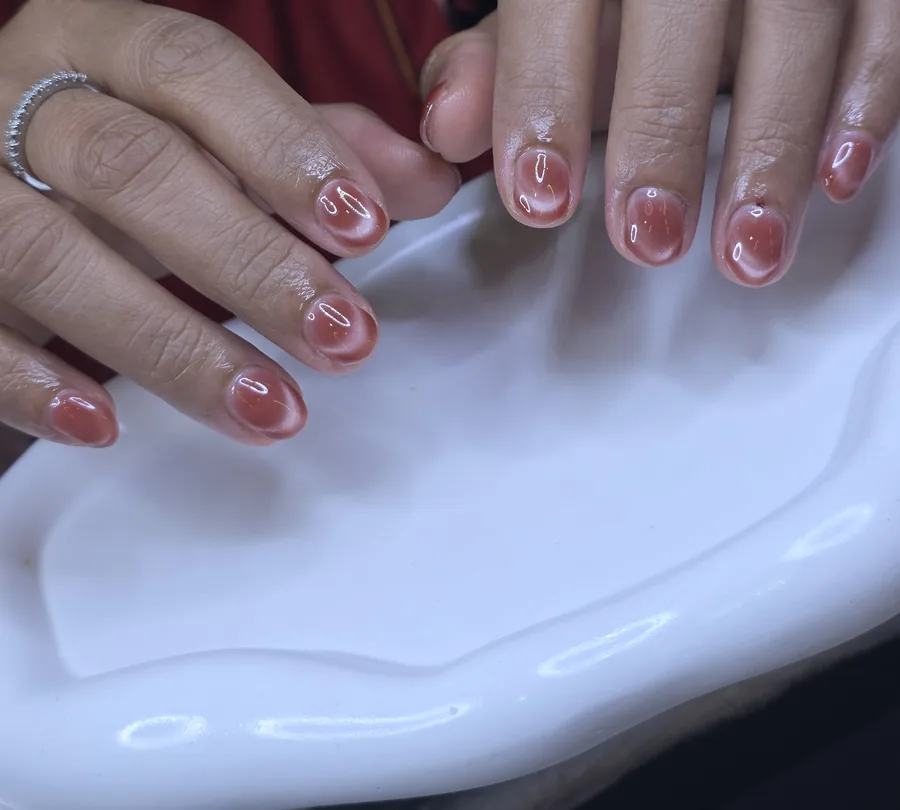
Nails trimmed short after removal still wear colour beautifully. A glossy rosy jelly like this suits short nails, looks healthy, and does not need you to wait for length.
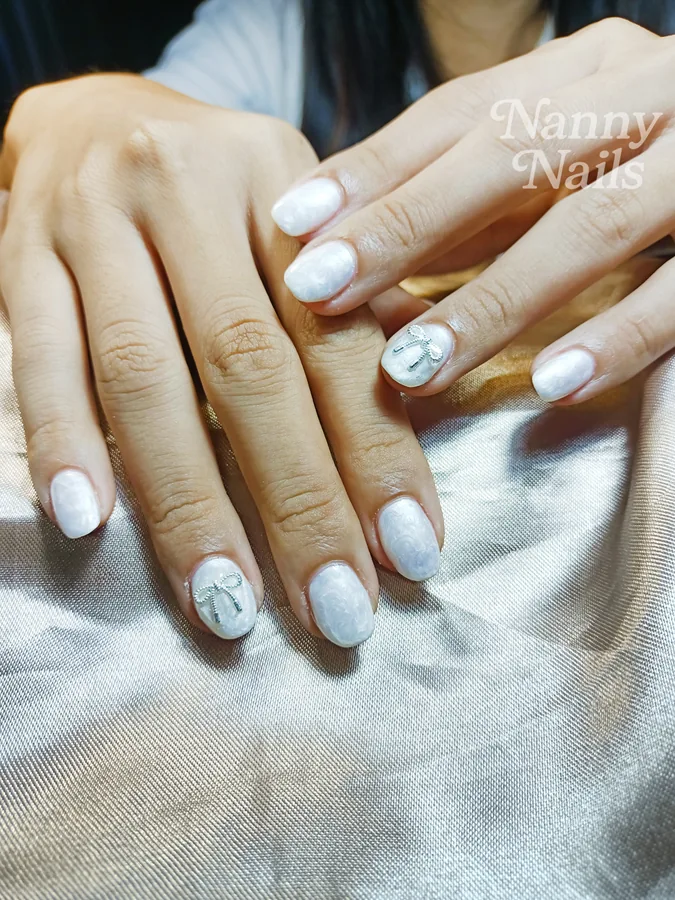
For something understated, milky white on short rounded nails, with a small bow on just one finger, is enough to keep hands looking neat while the nails slowly get stronger.
Removal and strengthening prices at the salon
At the salon, gel polish is taken down with a nail drill first and then wrapped in acetone.
| Service | Price |
|---|---|
| Remove gel polish, then a new set | 5 baht per nail (50 baht for a full hand) |
| Remove PVC extensions, then a new set | 10 baht per nail (100 baht for a full hand) |
| Gel removal only, nail break (includes shaping) | 100 baht |
| Removal only of PVC, hard gel or acrylic | 150 baht |
| Strengthening overlay, rubber base | 200 baht (colour not included) |
| Strengthening overlay, builder gel | 250 baht (colour not included) |
If you plan to rest your nails, choose removal only. If you are having a new set, removal is charged per nail together with the new work in one appointment. For example, gel polish in 1 colour at 200 baht plus rubber base at 200 baht comes to 400 baht, plus 50 baht to remove the old gel. When you book, mention that you have old nails to remove so we can allow time. See the full menu on our services and prices page. Every set comes with our 7-day care period, so you can go home and use your hands as normal with peace of mind.
What customers say about our gentle hands
(She does such good work, with a gentle touch and beautiful results. So fun to chat with, a really good time. Recommend.)Google review by อังค์วรา ไชยมาตย์
(Beautiful nails, such a gentle touch. Highly recommend.)Facebook review by Walailak Zeetrong
Read all our reviews on the reviews page.
Next time, nails that stay smooth after removal
Nails peeling in layers after gel removal usually does not mean your nails are unsuited to gel. It means that set was taken off by pulling, scraping or filing too deep, plus nails left dry after soaking without being moisturised. Next time your gel lifts, do not pick it. Soak it off properly or let the salon remove it, and the nail that grows in will be as smooth as before.
If your nails were already peeling before you ever had gel, the cause may lie in everyday habits instead. Read on in why do nails peel in layers. For more colours on short nails, browse our gallery.
FAQ
Why do my nails peel in layers after gel removal?
Mostly because of how the gel came off, not the gel itself. Pulling or picking gel takes the top layer of the nail with it, filing too deep thins the nail, and long soaks in remover without moisturising dry it out. The removal process is what damages the nail.
I picked my gel off and ruined my nails. Will they go back to normal?
The damaged part will not recover, but the new nail growing from the base is normal. A fingernail takes about 6 months to grow out fully. In the meantime, keep nails short, moisturise every day and wear gloves to wash up.
How long should I rest my nails after gel if they are peeling?
We suggest taking breaks from nail polish of one to two weeks or longer. If your nails peel badly, bend, or hurt, rest them and moisturise. If only the tips are peeling, a rubber base or builder gel overlay is an option.
How much does gel removal cost at the salon?
Removing gel polish before a new set is 5 baht per nail (50 baht for a full hand). Gel removal only is 100 baht, including shaping. Removing PVC extensions before a new set is 10 baht per nail. Removal only of PVC, hard gel or acrylic is 150 baht.
Do you do gel fills?
No. When customers come back for a new set, we remove the old one and start fresh every time. Removing gel before a new set is 5 baht per nail.
What is the salon’s 7-day care period?
If work done at the salon lifts or peels within 7 days, bring it back and we will fix it for free.
Where is the salon and how do I book?
We are in Ban Noi Tai, Soi 7/1, Mueang Nakhon Phanom. Open every day, nail appointments 09:00 to 18:00, 3 bookings a day. Book on LINE @nannynails or call +66 99 002 8935.
Send us a photo of your nails after removal
Send a photo of your nails as they are now on LINE. We will help you decide whether to rest them first or strengthen them straight away with a rubber base or builder gel. If you still have old gel on, tell us whether you want removal only or removal and a new set, and we will quote the total. We take 3 bookings a day, between 09:00 and 18:00.
Read more