Itchy and Swollen Around Your Nails After Gel Polish: Allergy or Just Irritation?
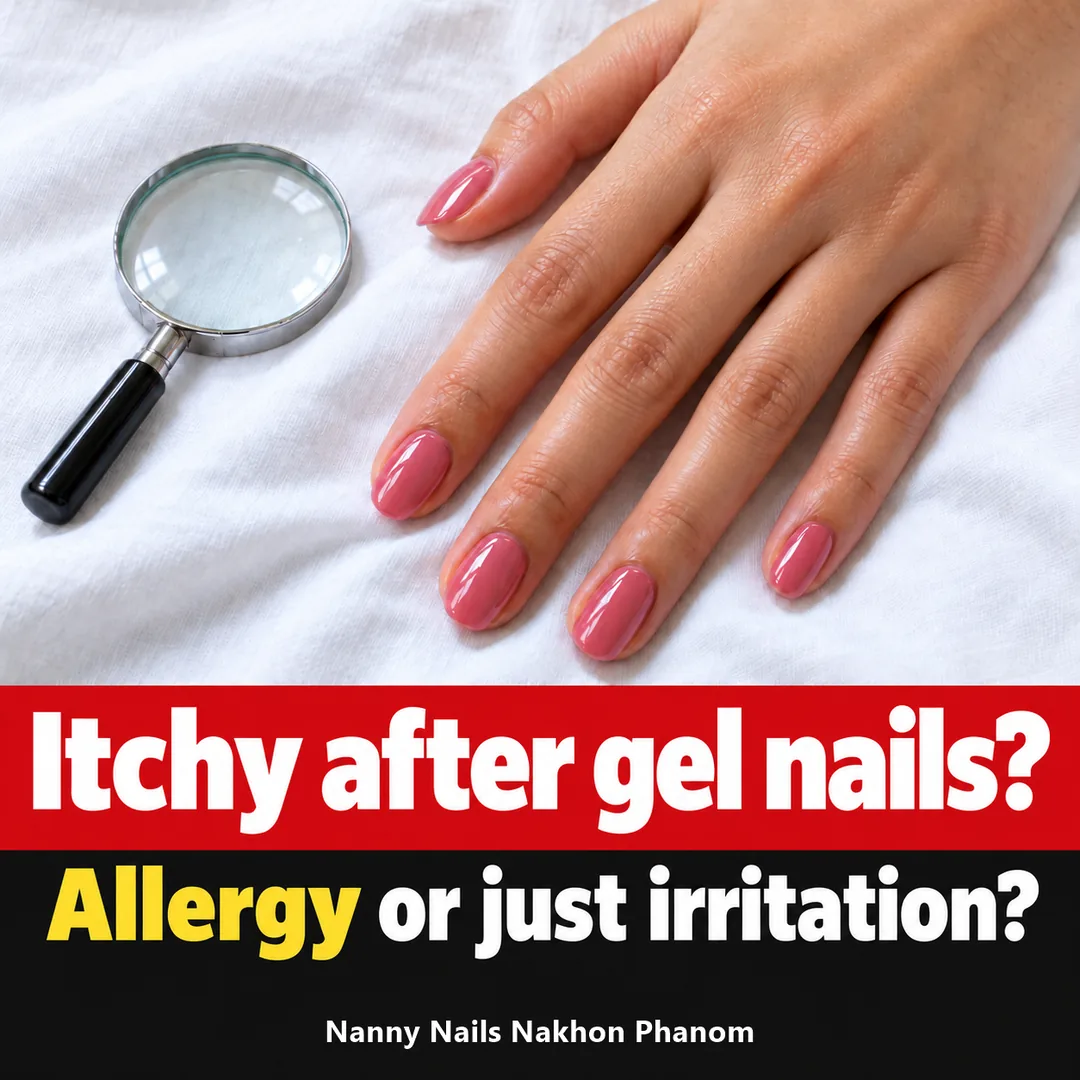
A few hours after your gel manicure, your fingertips start to itch and the skin around the nails turns puffy and red. You look at your hands and wonder: is this a gel allergy, plain irritation from the products, or the start of an infection around the nail? The three look very alike. You cannot sort them out in the mirror, and even a doctor combines an examination with a patch test to be sure. This article explains how the three differ, where the symptoms can show up, why a gel allergy is worth taking seriously, and which signs you should not wait on.
Let us be straight first: from a photo of your hands or a description of your symptoms, nobody can say for sure whether you are allergic or just irritated, and that includes a nail salon. What this article can do is show you the three possibilities, the clues for each, and the signs that mean go to a doctor today instead of waiting to see how it goes.
Why you cannot tell them apart yourself
A rash caused by something touching the skin is called contact dermatitis. There are two kinds. The first is irritant contact dermatitis, where a substance damages the outer layer of the skin directly. It is the more common kind. The second is allergic contact dermatitis, where the immune system reacts to the substance. It is less common. The two look almost the same: itchy, dry, cracked skin, sometimes blisters, mostly on the hands and face.
The chemicals used in gel and acrylic nails can cause both allergic and irritant reactions, and the only way to be sure is a patch test, where suspect substances are placed on the skin and the reaction is watched. That is done at a clinic, not at home and not at a nail salon.
There is also a third possibility people forget: an infection of the skin around the nail, called paronychia. It also looks like a red, swollen, sore nail fold, but it is not an allergy and it needs different care. Let us go through them one at a time.
The three side by side
This table shows tendencies. It is not a diagnostic tool. In real life they overlap, and one person can have two at once.
| Look at | Allergy (to the gel) | Irritation | Infection around the nail |
|---|---|---|---|
| What causes it | The immune system reacts to a substance such as the acrylates in gel | A substance or repeated contact damages the outer skin directly, no immune system involved | Germs such as bacteria or yeast get in through broken skin |
| When it starts | Slower, usually a few hours to 1 to 3 days after contact | Quicker, but it can also build up slowly from repeated contact | Acute bacterial type starts fast, a fungal type creeps in |
| Where | Fingertips, around the nails, and places the fingers touch such as eyelids and neck | Only where the substance touched, mostly the hands | Usually the fold beside one nail |
| Clues | Itchy, red, swollen skin, small clear blisters, the nail may loosen or lift | Stinging or itching, dry, cracked, peeling skin | Throbbing pain, red, swollen, warm, maybe yellow pus under the skin fold |
| How it is confirmed | A patch test at a clinic | History and examination, then avoiding what irritates | A doctor examines it, some cases need medicine prescribed by a doctor |
Notice that timing helps only a little. Irritation usually appears quickly while allergy takes longer, but irritation can also build slowly from repeated contact. Judging by timing alone can go wrong in both directions.
What gel allergy actually means
When people say gel allergy, they mostly mean an allergy to the chemicals in the gel itself, a group called (meth)acrylates, and the one found most often is called HEMA. It is not an allergy to the light from the lamp. We covered that at length in Are UV nail lamps dangerous? The short version is that the light helps the gel harden, and what causes the allergy is the gel chemical that touches the skin while it is still soft.
Of the people who go for allergy testing, about 2 in 100 turn out to be allergic to at least one of these chemicals. That figure comes from people who already suspected a problem. It is not the share of everyone who gets their nails done. But it shows the problem is real.
The most interesting point for anyone who has had gel nails for years is that some people are exposed to a substance for years before the body becomes sensitised to it. Ten gel manicures with no trouble does not mean the eleventh will be fine. Your body does not keep count of how many times you were safe.
Three things raise the risk:
- Uncured gel touching the skin. The allergy can develop when the chemical that has not yet hardened touches the skin.
- Gel that is not cured fully, for example under a lamp that does not suit the gel. The leftover chemical stays in contact with skin for longer.
- Doing it yourself at home with a kit. Kit instructions are often not detailed enough, so unhardened gel easily ends up on the skin.
Glue for press-on nails is another chemical family that can cause allergy. See Press-on nails at home for that.
How irritation differs from allergy
Irritation is the skin being damaged directly, with no immune system involved. It can happen to anyone who is exposed enough. The usual culprits are soap, detergent, solvents and frequent contact with water.
Think about the skin around the nails in a gel routine: wiping, grinding with the nail drill, soaking in remover, then water and dish soap the next day. We always tell customers that when removing gel they should soak only the fingertips, not the whole hands, to protect the surrounding skin, which gives you an idea of how sensitive that skin is to the remover.
Another difference is that irritation tends to stay where the substance touched and does not travel. Allergy is different, as the next sections show. An allergic rash can come from only a brief touch if it is something you are already allergic to.
Infection around the nail, the third one people forget
Acute infection around the nail usually affects the fold beside just one nail, with pain, redness and swelling, sometimes yellow pus under the skin fold, and the nail may lift. It is usually caused by bacteria. Bacterial infections come on suddenly while fungal ones develop slowly. Skin around the nail that is sore, red, swollen and warm can be a sign of infection and you should see a doctor.
The door that lets germs in is broken skin. Nail biting, picking at the skin around the nails, manicures and artificial nails are all ways that opening can happen, and so is pulling off a hangnail or trimming or pushing back the cuticle. If picking the skin around your nails is a habit, read Peeling skin around the nails.
What makes it harder is that they can stack. People allergic to nail gel or acrylic can have nail inflammation, a nail that lifts, and an infection around the nail as secondary problems, and long-lasting infection around the nail is linked to dermatitis of the nail fold. If the nail itself turns yellow or green along with symptoms around the nail, read about fungus in Nail fungus or just yellow and have a doctor look at it.
It does not only show up on the fingertips
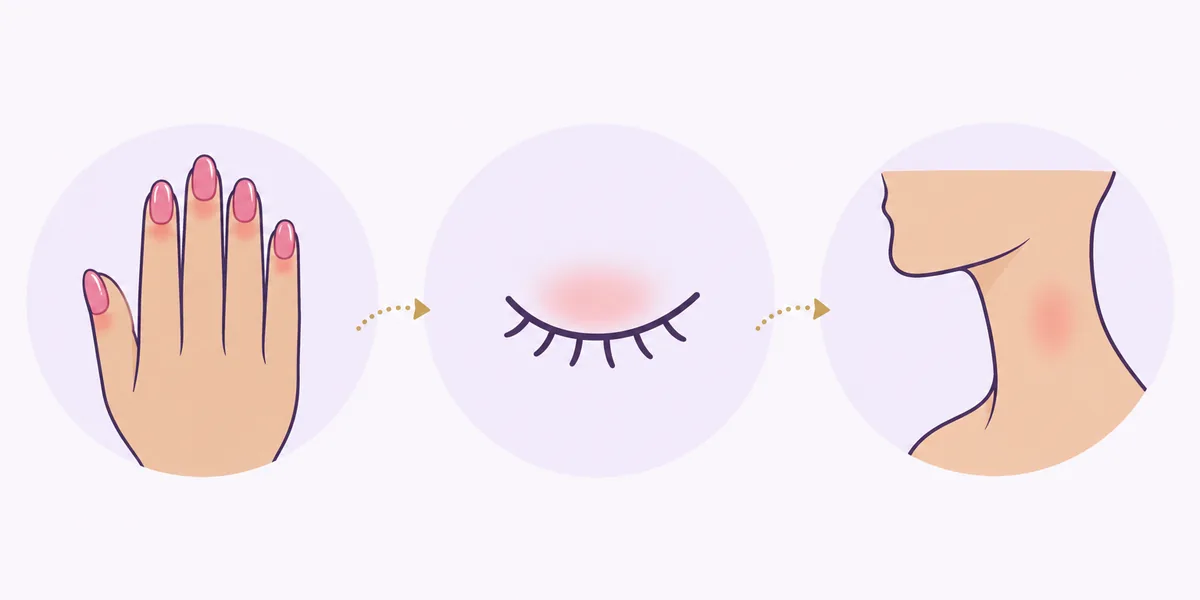
This is what many people who get their nails done never hear. A reaction to nail gel does not always stay on the fingertips. The red, itchy rash can appear on the fingertips or anywhere the nails have touched, such as the eyelids, face and neck. On the fingers it is usually just red, swollen fingertips, but the dermatitis more often appears on the eyelids, in and behind the ears, around the mouth and chin, and on the sides of the neck.
The reason is that our hands touch our face all day without us noticing, and they carry the substance with them. An allergen carried on the fingers can cause dermatitis in other places, including the eyelids. That means a rash on the eyelids or neck can easily be blamed on a cream or make-up, with nobody thinking of the nails.
That is why we tell anyone with these symptoms to have a doctor diagnose it even when the rash is away from the nails, so they know what to avoid. If your eyelids or face turn red and itchy after a gel manicure, tell the doctor about your nails too.
On the fingertips themselves you may see red, swollen skin, a nail that loosens or comes off, and some people feel tingling or pins and needles. An allergic reaction can start from several hours to several days after the manicure, with swelling, itching, changed skin colour, fluid-filled bumps around the nail or a lifted nail.
Once you have it, it tends to stay
This is why it needs to be taken seriously. Sensitisation to an allergen is usually lifelong. The rash clears when the substance is avoided, but it can return even with a small amount of contact. The only way to get rid of contact dermatitis is to avoid the cause.
One more thing to know: these chemicals are not only in nail gel. They are also in dental materials and medical devices, so an allergy can have lifelong consequences for dental treatment and surgery. If a doctor confirms you are allergic, tell your dentist and every doctor who looks after you. Whether you can have some other kind of nails instead is a question for the doctor who examined you. A salon cannot answer it for you.
One caution: the figures above come from patients who went to see a doctor. They cannot say how common it is among everyone who gets their nails done. But because the effect is long and cannot be reversed, it should not be brushed aside.
If you have symptoms now: what helps and what does not
A nail salon cannot give treatment advice, and this article does not either. But some general points are agreed by the same sources.
- Do not wait for it to fix itself if it is not improving. See a doctor for symptoms that persist, keep coming back or are severe. If skin is still reacting after two to four weeks, it is time to see a doctor. If it is worse than mild, do not wait that long.
- Do not yank or peel the gel off yourself. Picking at gel that starts to lift is a bad idea. Ask the doctor when and how to take it off. If the skin is already inflamed, hurting it more does not help.
- Skip the next gel manicure until a doctor tells you what caused this. If you suspect a product, stop using it straight away.
- Write it down and take photos. When you had your nails done, how many hours later it began, where it showed up, and a photo of the skin at its worst. This helps the doctor take your history.
- Do not rush to buy something to rub on. A cream bought on your own can hide the signs, and choosing what to use is for the doctor once the cause is known.
Signs you should not wait on
These are the signs to go quickly for, most urgent first.
- Lips, mouth, tongue or throat swelling quickly, or trouble breathing or swallowing. Call an ambulance or go to the emergency room immediately. These are signs of a severe allergic reaction needing emergency help. Breathing problems from nail gel are very rare, but if it happens, do not wait.
- Fever, chills, feeling unwell all over, or red streaks running from the finger. These are signs an infection around the nail is spreading. See a doctor that day.
- Throbbing pain, redness, swelling, warmth or pus around one nail. This matches an infection around the nail, which should be seen by a doctor. A spreading infection can become cellulitis (an infection of the skin layers), and some cases need antibiotics by mouth, which is the doctor's decision.
- Red, swollen, painful skin around the eye, or a red eye. An infection of the skin around the eye is very serious. Go to a doctor the same day.
- A rash on the eyelids, face or neck after a manicure. Do not wait for it to pass. Get it diagnosed even if the rash is away from the nails.
- A nail that loosens, lifts or comes away from the nail bed. It is a sign seen in allergy.
- A rash that does not improve, or comes back every time you get your nails done. It is time to find the cause properly, and a patch test can help answer that.
If you are not sure which item you are in, treat it as the more urgent one. Going to the doctor and hearing that it is nothing is not a wasted trip.
Why the salon does not do gel for someone who has had a gel allergy
We want to say this plainly because it is a safety policy that affects you. A nail salon is not a clinic. We do not have the equipment or the medical training to know which substance you are allergic to, and no way of knowing how your body will react to this round of gel. A gel allergy lasts, and it can overlap with an infection. Putting gel again on skin that has already had a problem is a risk you should not have to take for one set of pretty nails.
So if you tell us that you have had a gel allergy or an allergy to gel polish, we will not do gel for you, and we ask you to see a doctor first. This is not judging you. It is choosing the safe side. And please do tell us honestly. We would much rather be told than have it kept quiet and something go wrong later.
If you have never had any reaction after gel nails, and you are just reading this and feel a bit worried and want to ask first, ask us. We answer chats 24 hours a day on LINE.
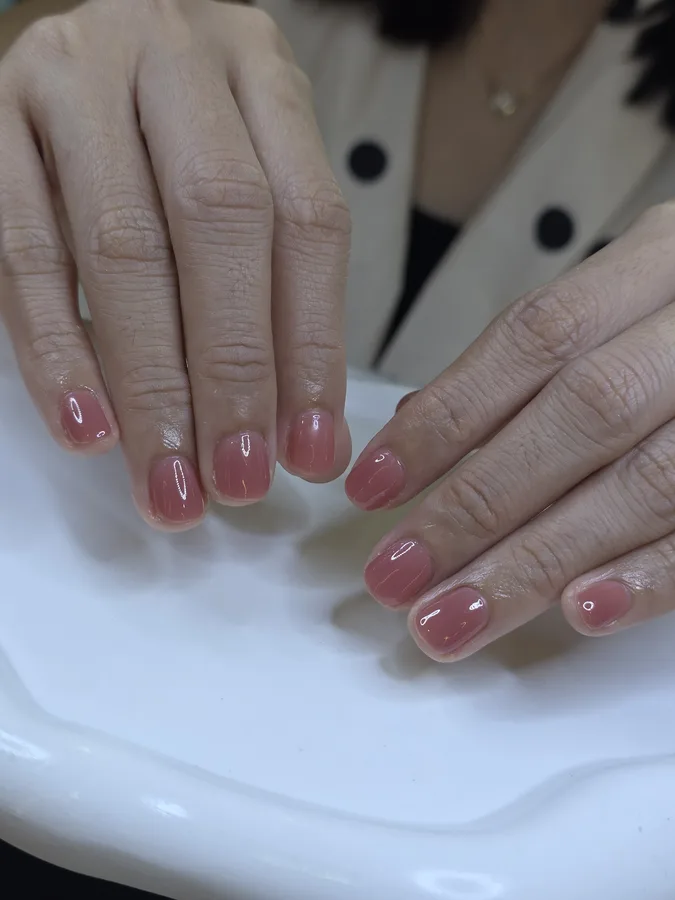
Nanny Nails is a home nail salon in Ban Noi Tai, Nakhon Phanom. The owner does every set herself, and the shop has 144 Google reviews with a 5.0 rating.
Once your nails are done, we look after you for 7 days and you can go about your life as normal. To see what to avoid after a gel manicure, read What not to do after a gel manicure, and to choose a design for next time, see our gallery.
In short
- Itch and swelling around the nails after gel can be an allergy, irritation or an infection, and you cannot tell them apart by eye.
- A gel allergy comes from uncured gel touching the skin. You can become allergic after years of no problems.
- An allergic rash can appear on the eyelids, face and neck, not just the fingers.
- Sensitisation usually lasts for life and can matter for dental work and surgery.
- Trouble breathing, fever, red streaks from the finger, pus around the nail and swelling around the eye are signs you should not wait on.
- If you tell us you have had a gel allergy, we do not do gel for you and ask you to see a doctor first.
FAQ
What are the symptoms of a gel polish allergy?
Red, swollen, itchy skin around the nail or on the fingertip, sometimes small clear blisters, and the nail may loosen or lift. It can start several hours to several days after the manicure, and it can also show up on the eyelids, face or neck because the hands touch them. But irritation or an infection can look the same, so it needs a doctor.
How is a gel allergy different from irritation?
An allergy is the immune system reacting to a substance. It usually starts more slowly and can appear away from the fingers. Irritation is a substance damaging the skin directly. It usually stays where the substance touched and is more common. You cannot tell them apart from how the skin looks alone. Doctors use history, examination and sometimes a patch test.
I have had gel nails for years with no problem. Can I become allergic later, and does it go away?
Yes. Some people are exposed for years before the body becomes sensitised, and sensitisation usually lasts for life. The rash clears when the substance is avoided but can return with new contact. It can matter for dental work and surgery, so tell your doctors every time.
The skin around one nail is red, swollen, painful and has pus. Allergy or infection?
A sore, red, swollen fold beside one nail, with pus, matches an infection around the nail (paronychia), but an allergy can lead to an infection too. The salon cannot tell which it is, so please see a doctor. If you have a fever, chills or red streaks running from the finger, go the same day.
Does the salon do gel for someone who has had a gel allergy?
No. If a customer tells us she has had a gel or gel polish allergy, we ask her to see a doctor first. This is the shop's safety policy: we are not a clinic and cannot tell which substance a customer is allergic to. If you have never had a reaction and just want to ask, send a photo of your hands on LINE.
What is the shop's 7-day care period?
If work done at the salon lifts or peels within 7 days, bring it back and we will fix it for free.
Where is the salon and how do I book?
We are in Ban Noi Tai, Soi 7/1, Mueang district, Nakhon Phanom. Book on LINE @nannynails or call 099-0028935. We take 3 bookings a day, 09:00 to 18:00. The deposit is 100 baht per booking. Tell us 1 hour ahead to move your booking and keep the deposit once. If you are more than 20 minutes late, we reserve the right to cancel the booking and keep the deposit.
Never had a reaction and just want to ask first? Send it over
If you have never had a reaction after gel nails and just want to ask before booking, send a photo of your hands, or a design you like, to LINE @nannynails. We look at the condition of your nails before your appointment and answer your questions about how we work. If what you are seeing now is itching, swelling or redness, or you have had a gel allergy before, please see a doctor first. We take 3 bookings a day, 09:00 to 18:00.
Read more