Thin Natural Nails After Extensions: 5 Mistakes People Make When Applying and Removing Them
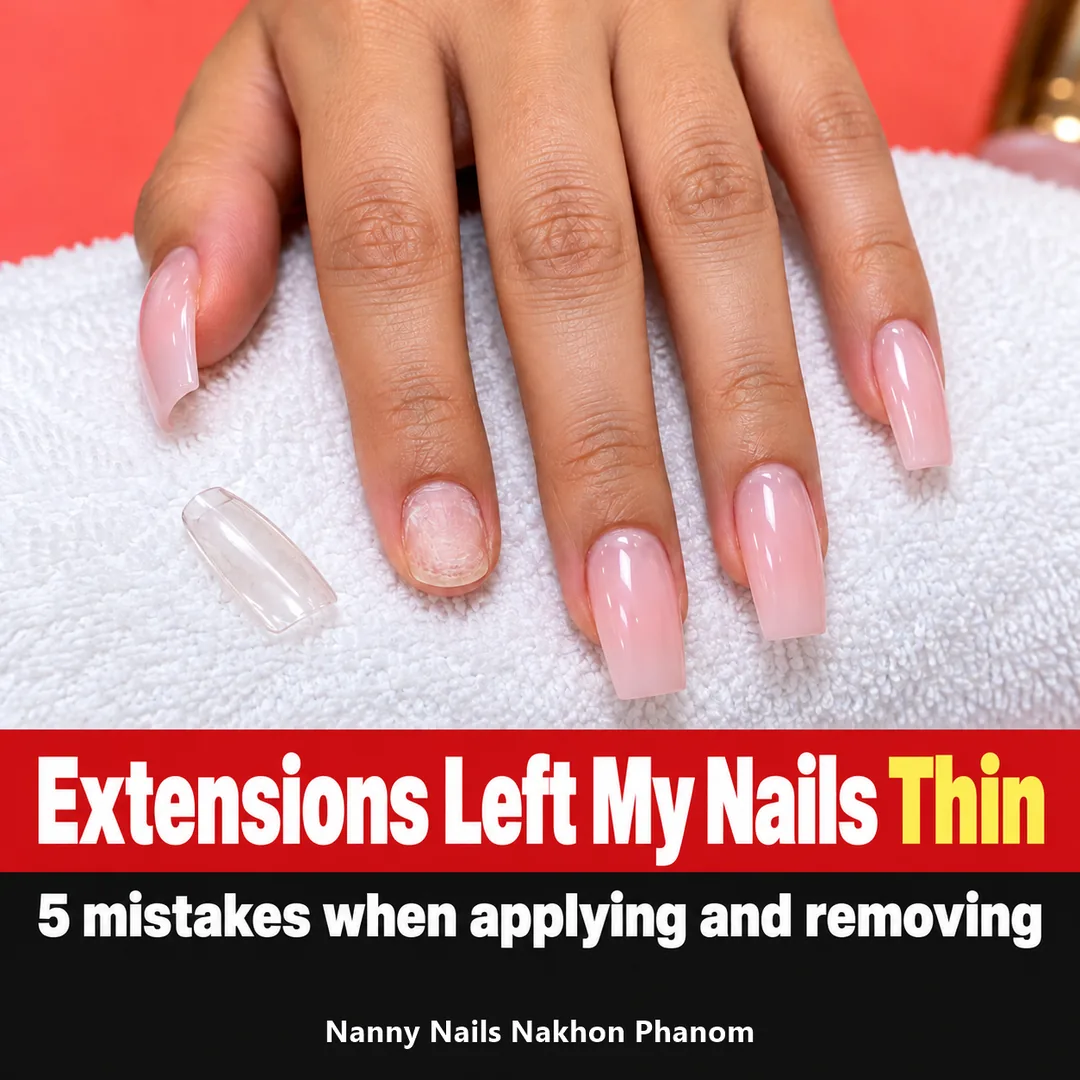
Three weeks ago you had gorgeous long nails for an event. Today two of them came off, so you picked off the rest, and got a shock. The nails underneath are dull and chalky, peeling in flakes, and bend at the slightest press. Even hot washing-up water stings a little. This article explains why natural nails get thin after extensions, the 5 mistakes people make most often when applying them and when removing PVC extensions, and how to care for your nails once the damage is done.
The good news is that nails thinned by nail services are rarely damaged for good. Your nails grow new plate all the time, and thin nails usually are not caused by the fake nail itself but by a few steps that went wrong without anyone noticing. Once you know which step it was, you can get extensions again without trading away your own nails.
Where does the nail go when it gets thin?
Nails are made of a protein called keratin, laid down in many thin layers pressed together into one plate, a bit like sheets of paper. The top layers are the hardest and smoothest and work like a protective shell.
When we say a nail is thin, part of those top layers is gone. They disappear in one of two ways: they get filed away, or they get pulled off with the fake nail during removal. Both happen during nail services. Artificial nails can leave your nails thin, brittle and dry, and both putting on and taking off fake nails can cause brittle nails and breakage.
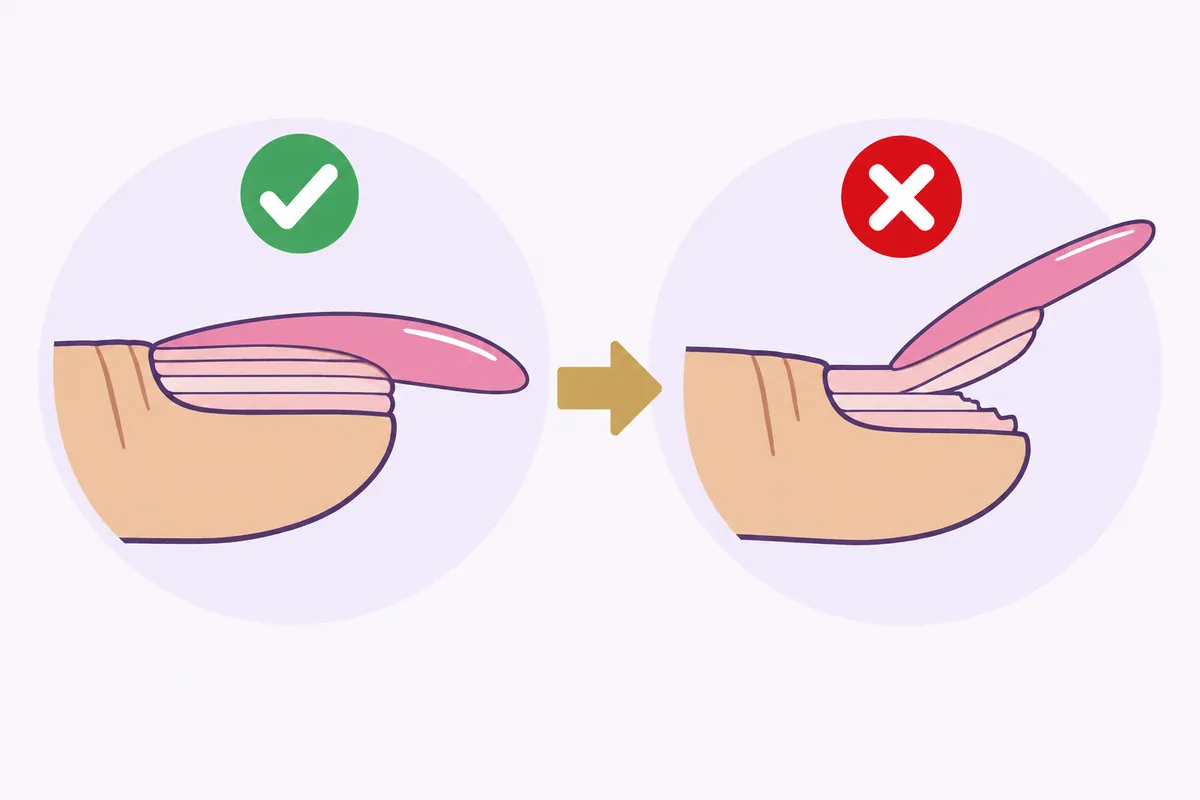
The picture above shows what happens when a fake nail is pried off while it is still stuck firmly. It does not come off alone. The top layers of your own nail that it was bonded to come away with it, and what is left on your finger is the thinner, softer layer underneath.
First, check: are your nails thin?
After taking off extensions, look at your natural nails. If several of these fit, a good part of the top layers has gone.
- The tip bends when you press it lightly. A normal nail feels firm and springs back. A thin one feels like soft plastic.
- Dull, chalky white patches where the adhesive or gel used to sit, unlike the edges that are still shiny.
- Thin flakes peeling at the tip, with the nail splitting into layers like wet paper.
- Stinging with hot water or when you type hard.
- Tips that tear easily, catching on fabric or socks.
No need to panic if this sounds familiar. It just means your nails need time off, and it is worth checking the 5 points below to see which one happened last time, so it does not happen again.
Mistake 1: wanting them to stick as hard as possible, so the nail gets buffed too much
Plenty of people have had an extension pop off mid-cycle, so next time they ask the technician to buff hard so it holds. Or, doing it at home, they rub the whole nail with a coarse file until it is completely matte, thinking rougher means stronger grip. It sounds logical, but it is the most overlooked starting point for thin nails.
Filing your natural nail until it is rough so an artificial nail will stick thins the nail and makes it weaker, because roughing up the nail surface thins and weakens the top of the nail plate. Each buffing removes a little of the top layers, and if you get extensions every month, that buffing happens every month.
In practice, extensions that pop off early usually do not come from too little buffing. They come from oil left on the nail, cuticle left on the plate, a fake nail that is the wrong size for your nail, or too much length. At our salon we clear the nail by pushing back the cuticle first, then trimming only the excess. If you have had lifting before, tell the technician which finger lifted and whether it lifted at the base or the tip. That helps far more than asking for harder buffing.
Mistake 2: going longer than your daily life allows
The longer the nail, the more the tip works like a lever. Every time the tip hits a table edge or a car door, or you use it to open a can, the force travels straight back to the base of your natural nail.
The longer the fake nail, the more likely it is to cause the natural nail to separate from the nail bed (this is called onycholysis), which also makes it easier for germs to get underneath. The reason: people wearing long artificial nails often get this kind of separation from knocks, because the fake nail sticks to the nail plate more strongly than the nail plate sticks to the skin beneath it. When it is levered, the first thing to give way is your own nail.
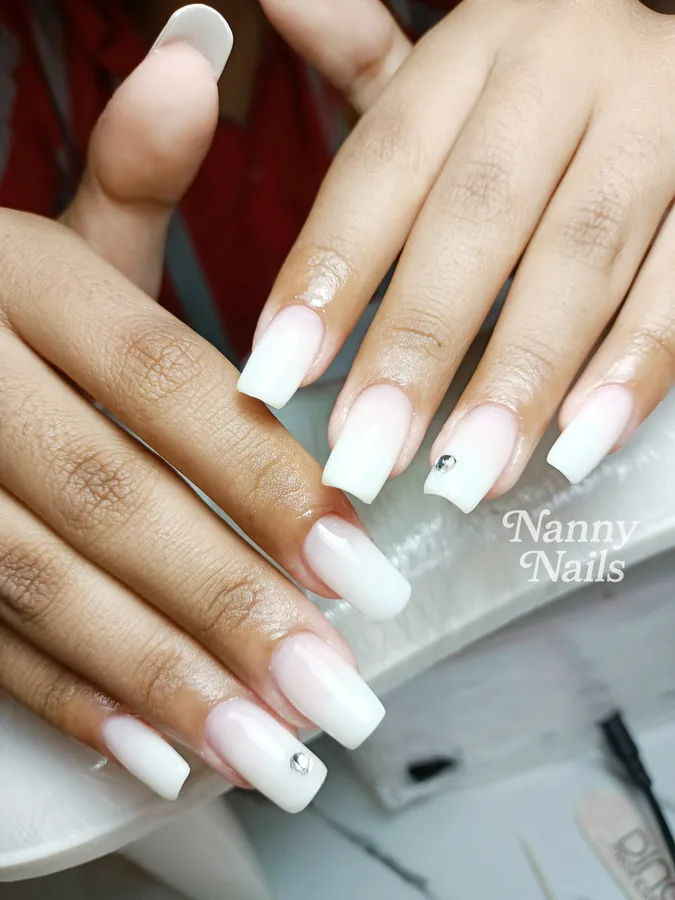
Long square nails like these look stunning in wedding or graduation photos. Just know they suit times when you can be careful with your hands. If you do housework, type all day or carry a child every day, a medium length will last the whole cycle without putting your natural nails at risk. We covered how to pick a length that fits your work in How long do PVC nail extensions last.
Mistake 3: keeping them on after they start lifting, or gluing them back yourself
Your nails grow every day, so after two or three weeks a gap appears at the base between the fake nail and the cuticle. If you want to wear artificial nails for more than a few weeks, you need touch-ups every 2 to 3 weeks to fill the gap, and that frequent touch-ups can seriously damage your natural nails too.
The real trouble starts when an edge begins to lift. Most people keep wearing it because it feels like a waste, or squeeze some glue into the gap to stick it back down. Either way, water, soap and moisture can sit trapped under the fake nail all day. Fake nails trap moisture, creating the damp spot that fungi and bacteria like. Nails can also turn green from bacteria where water is trapped under lifted extensions.
The better move is to have it removed properly as soon as you see an edge lifting or a finger starting to shift, then redone, rather than waiting for it to fall off. The glues people reach for at home, both the kind sold with press-on nails and general-purpose super glue, are covered separately in DIY press-on nails: how the wrong glue damages your real nails.
Mistake 4: picking, prying or pulling the fake nails off yourself
This is the biggest culprit and the easiest to fall into, because a nail that has lifted at one corner is very tempting to pick. Once one finger is done, the rest follow. Some people use tweezers, the tip of scissors, or another nail to lever under the edge.
While the fake nail is still attached, the adhesive is still holding the top layers of your nail tightly. So pulling does not only separate the fake nail from your nail. It separates the layers of your own nail from each other. The result is what the diagram above shows: the top layers go with the fake nail and a thin, chalky nail is left on your finger. The same warning applies to gel: do not pick it off, because it can seriously damage your nails. Acrylic extensions are best removed by a professional rather than by yourself.
The right principle for removing PVC extensions is to soften the adhesive first so the fake nail loosens by itself, with no prying. It takes time and patience. For the soak-to-soften idea as used with gel polish, see Can you remove gel nails at home? But PVC extensions are longer and thicker than gel colour, so salon removal is safer. The salon removes gel colour and PVC extensions the same way: a nail drill first, then the nails are wrapped in acetone. For PVC extensions, removal only is 150 baht, or 10 baht per finger if you are getting a new set straight after.
Mistake 5: a new set straight away every time, with no rest and no care
Once you are used to long nails, it is hard to look at short ones even for a day. Off comes one set, on goes the next, all year round. The top layers lost each round never get a chance to grow back.
We tell customers to save artificial nails for special occasions, because the time without them lets your nails repair themselves, and to apply petroleum jelly to the nails and cuticles several times a day between sets. Acetone soaks also leave nails dry and brittle, and damage from extensions takes about six months before healthy nail grows in. That matches the general figure that a fingernail takes 6 months or more to replace the whole plate.
Resting does not mean bare hands for months. During a break you can wear gel colour on short nails, or skip a round or two and save long extensions for the occasions that really matter. That way your nails get to grow some fresh layers.
If your nails are thin right now, how to care for them
If you have just taken extensions off and your nails are already thin, there are only a few things to do at home, but they need doing consistently.
- Keep nails trimmed level with your fingertips. Short nails get levered and snagged less, so the thin part can grow out before it tears.
- Apply cream or petroleum jelly to nails and cuticles several times a day, especially after washing your hands.
- Wear gloves for washing up and cleaning. Water and detergent make already thin nails drier and more likely to peel.
- Stop using your nails as tools. Use your fingertips or a tool to peel stickers, open lids or scrape off marks.
- File in one direction. If a tip splits or flakes, file gently one way, not back and forth.
- Do not buff the surface smooth yourself. The chalky patches will grow out. Buffing only makes the nail thinner.
There are more everyday habits that quietly damage nails in 6 habits that damage your nails, and if your nails were brittle even before extensions, read Brittle nails: causes and care.
Can you get PVC extensions again if your nails are thin?
It depends how thin. If the nails are only chalky with a little peeling at the tip, with no pain and no gap between nail and skin, most people can still have their nails done, but this time it is wise to choose a shorter length. And not everyone needs long extensions every time. If you just want neat hands, gel colour on your natural nails is enough.
If nails are so thin that colour has nothing to hold on to, we first build up the nail surface with rubber base or builder gel before the colour, which gives the colour something to grip. The difference between the two is in Rubber base vs builder gel. But if a nail hurts, is swollen or red, or has lifted from the skin with a white gap, rest it and have a doctor look first. Nothing should go on top of it.
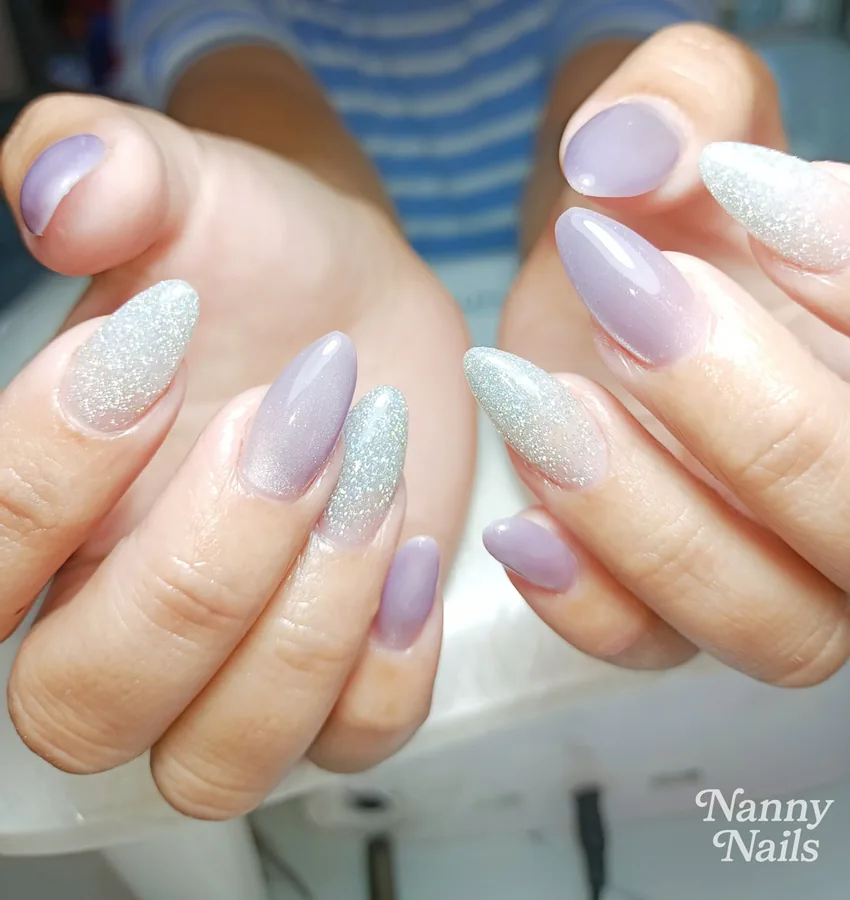
A medium almond length like this is a good choice for the first set after a break. The rounded tip rarely catches on fabric, you can use your hands almost as normal, and there is much less leverage on the base of the nail than with very long nails.
Extension and PVC removal prices at the salon
| Service | Price |
|---|---|
| PVC extensions, hands (colour not included) | 200 baht |
| PVC extensions, feet (colour not included) | 250 baht |
| Gel colour, hands, 1 colour | 200 baht |
| Remove PVC extensions and do a new set | 10 baht per finger (100 baht per hand) |
| Remove PVC extensions only, to rest your nails | 150 baht |
| Nail strengthening with rubber base / builder gel (colour not included) | 200 / 250 baht |
We only do PVC extensions, not acrylic, and we do not do fills: every round the old set comes off and a new one goes on. Colour prices include shaping, base coat and top coat. See the full menu on the services and prices page. Every service comes with our 7-day care period.
Signs you should see a doctor, not a nail salon
- The nail separates from the skin underneath, showing a white or yellow gap that does not reattach.
- Swelling, redness, warmth, pain or pus around the nail, which are signs of infection.
- The nail turns green, brown or yellow, or the surface crumbles.
- An itchy red rash on your fingertips or around the nails after a nail service.
- Thin nails that do not improve at all after several months of rest.
What customers say about our extensions and gentle hands
(Lovely owner, good service, and beautiful extensions.)Google review by ธิดารัตน์
(Beautiful nails, such a gentle touch. Highly recommend.)Facebook review by Walailak Zeetrong
Read all reviews on the reviews page.
Next time, long nails with your own nails still intact
Thin nails after extensions mostly come down to these 5 points: buffing too hard to make them stick, going longer than daily life allows, wearing them after the edges lift, picking or prying them off, and redoing them every round without a break. Fix all five and long nails are simply something pretty again, not something you pay for with your own nails.
If you are still choosing a type, read PVC, acrylic and gel extensions compared. If you like buying ready-made press-on nails to put on at home, carry on with DIY press-on nails: how the wrong glue damages your real nails, and browse long nail designs in the gallery.
FAQ
Why are my nails thin after extensions?
Usually because of the process rather than the fake nail itself: buffing the natural nail too hard, going so long the nails get levered often, wearing them after the edges lift, picking or prying them off, and back-to-back sets with no rest. Filing nails rough thins and weakens them.
Can I remove PVC extensions at home?
Picking or prying them off is not recommended, because the top layers of your nail come off too. The right principle is to soften the adhesive so the fake nail loosens by itself. PVC extensions are thicker and longer than gel colour, so salon removal is safer. Removal only at our salon is 150 baht.
How long until thin nails recover after extensions?
The thin part does not thicken where it is. New nail grows in to replace it. A fingernail takes 6 months or more to replace the whole plate, and damage from extensions takes about six months to grow out.
Can I get PVC extensions again if my nails are thin?
If they are only chalky or peel a little, with no pain and no gap from the skin, usually yes, but choose a shorter length. If nails are too thin for colour to hold, we build up the surface first. If there is pain, swelling or separation, rest and see a doctor first.
Do very long extensions damage natural nails?
They carry more risk than a medium length. The longer the fake nail, the more likely it is to make the natural nail separate from the nail bed and let germs in. Very long nails suit special occasions when you can be careful with your hands.
What is the salon’s 7-day care period?
If work done at the salon lifts or peels within 7 days, bring it back and we will fix it for free.
Where is the salon and how do I book?
We are in Ban Noi Tai, Soi 7/1, Mueang Nakhon Phanom. Open every day, nail appointments 09:00 to 18:00, 3 bookings a day. Book on LINE @nannynails or call +66 99 002 8935.
Send us a photo of your nails first
Take a photo of your hands after removing extensions, or of the extensions still on, and send it on LINE. We will help you decide whether to remove the PVC and rest first, go for gel colour on short nails, strengthen the nail surface, or get a new set and at what length. 3 bookings a day, 09:00 to 18:00.
Read more